






Orthodontist SEO Services That Helps Your Practice Rank for Invisalign, Braces, and Clear Aligner Searches in Your Market
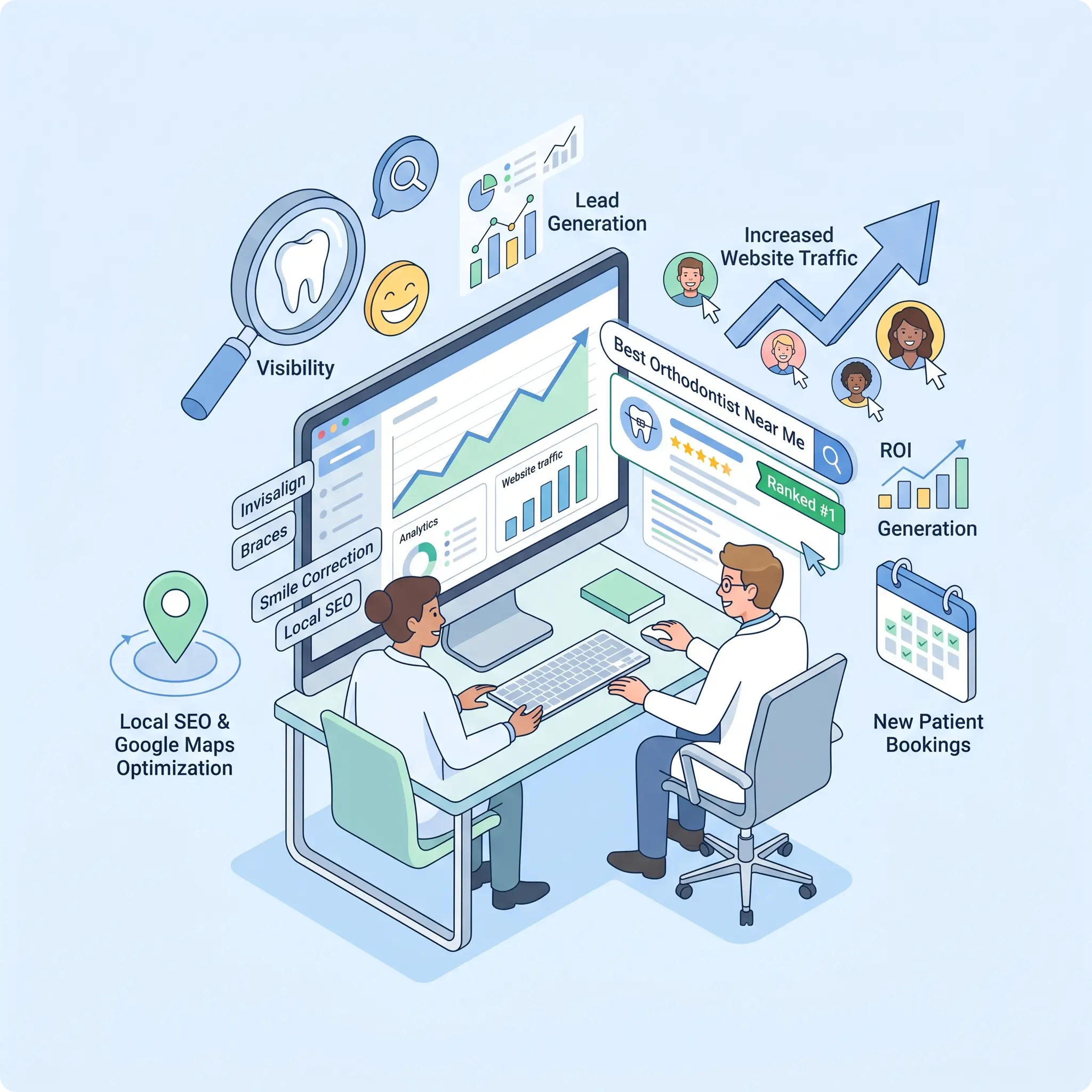
Orthodontics is one of the most local-search-dependent specialties in all of healthcare. Roughly 95% of orthodontic patients come from within a 15-mile radius of your practice — which means dominating local search in your market isn’t a marketing preference, it’s the primary driver of new case volume.
Full Invisalign cases run $5,000 to $8,000 and traditional braces $4,000 to $7,000. A single new case from organic search returns more than most practices spend on local SEO in an entire year. The economics are unusually favorable — which is exactly why the practices investing in orthodontist SEO are pulling away from competitors who rely on referrals and paid advertising alone.
At DentalSEOServices.co, we rank orthodontic practices for the searches that produce new case starts — Invisalign, braces, clear aligners, and treatment-specific queries across both adult and pediatric segments. All dental SEO. Nothing else.


Why Orthodontic Patients Search Differently — and Why Generic Dental SEO Fails Them
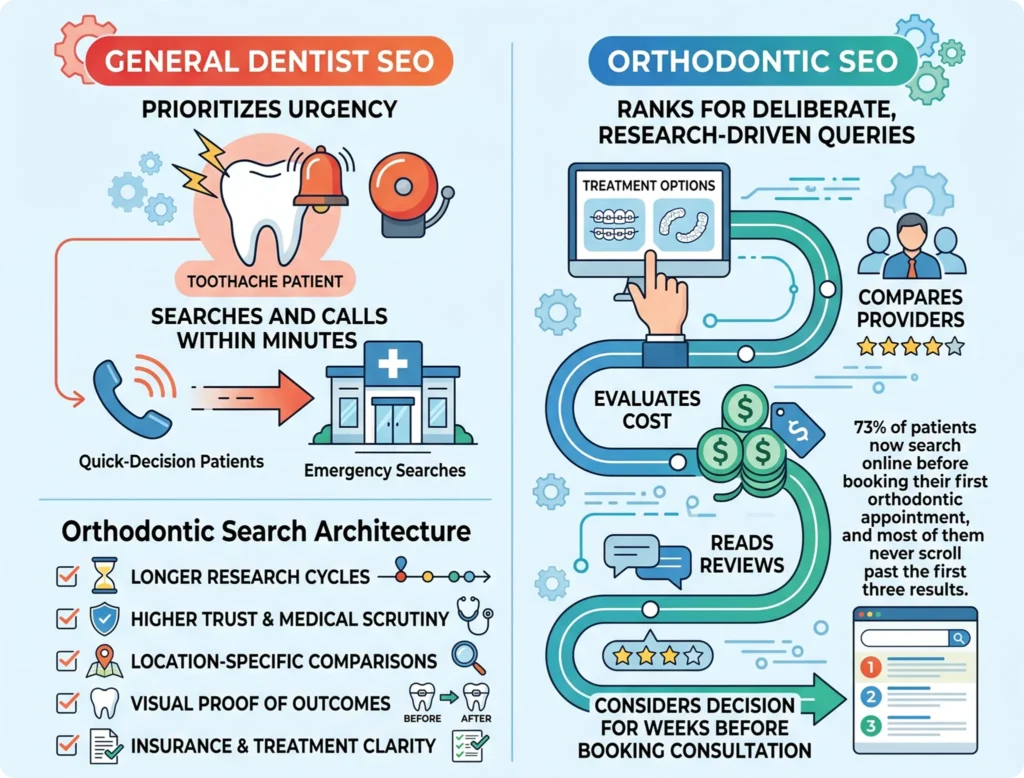
Most orthodontists lose ground in SEO because they copy general dental SEO playbooks. That is a fundamental mistake. Dentist SEO prioritizes urgency. Orthodontists rank for deliberate, research-driven queries.
A patient with a toothache searches and calls within minutes. An orthodontic patient — or the parent of one — researches treatment options, compares providers, evaluates cost, reads reviews, and considers the decision for weeks before booking a consultation. About 73% of patients now search online before booking their first orthodontic appointment, and most of them never scroll past the first three results.
The orthodontic search journey requires a completely different SEO architecture than general dentistry. Orthodontic patients face longer research cycles, higher trust and medical scrutiny, location-specific comparisons, visual proof of outcomes, and insurance and treatment clarity requirements — all of which need to be addressed in your SEO content and page structure before a patient will convert to a consultation.
A generalist dental SEO strategy built for emergency searches and quick-decision patients will consistently underperform for orthodontics. We build SEO specifically for how orthodontic patients actually search and decide.
What Orthodontist SEO Looks Like in Practice

Treatment-Specific Keyword Architecture
High-value orthodontic keywords fall into three categories: treatment-specific terms like "braces" and "Invisalign," demographic-focused phrases like "adult braces" and "pediatric orthodontist," and cost-related queries like "braces cost" and "Invisalign payment plans" — which indicate patients in the final decision-making phase, closest to booking.

We map every keyword category for your practice and build the page structure and content that captures patients across all three. Treatment pages for each offering (Invisalign, traditional braces, clear aligners, early interceptive treatment), audience-segmented content for adults and parents, and cost-related pages that address the financial questions patients are actively searching before they commit to a consultation.

Audience-Segmented Content and Landing Pages
We build separate, optimized landing pages for your adult Invisalign audience and your pediatric/teen patient audience. Each page targets the specific keywords, addresses the specific concerns, and contains the specific trust signals that convert that audience — rather than diluting both into a single page that speaks to neither clearly.

This segmentation does more than improve conversion. It expands your keyword footprint across two distinct search clusters, meaning more pages ranking for more targeted queries, and more entry points into your practice's digital presence.

Local Map Pack Optimization for Orthodontic Searches
Google and AI platforms treat orthodontists as medical specialists, not general dental providers. Your SEO must reflect that distinction. Your Google Business Profile needs the "Orthodontist" primary category — not "Dentist" — along with service entries specifically for Invisalign, braces, and your other offerings.

We optimize your GBP for orthodontic-specific map pack visibility: accurate specialty categorization, treatment-specific service listings, before-and-after photo content that increases Google Maps engagement significantly for orthodontic practices, and the review generation system that builds the volume and recency signals that local pack rankings require.
You can expect 30 to 45 days for meaningful Maps movement and 60 to 90 days for consistent lead growth from GBP optimization — making it the fastest component of an orthodontic SEO engagement to show results.

Content That Answers What Orthodontic Patients Actually Ask
Google has become very good at distinguishing between content that serves a reader and content that exists primarily to target a keyword. One genuinely comprehensive guide to Invisalign for adults — covering the entire decision process from initial questions through aftercare — outperforms ten thin blog posts on loosely related topics.

We build the content architecture that answers what orthodontic patients are genuinely asking: Invisalign versus traditional braces, cost breakdowns, treatment timelines, what a first consultation involves, whether their child needs early treatment, insurance and financing options. Each piece is built to depth — not 300-word stubs, but thorough, credentialed answers that Google surfaces in featured snippets, People Also Ask boxes, and AI-generated overviews.

AI Overview and Generative Search Optimization
AI-powered search tools like ChatGPT and Google AI Overviews are now answering orthodontic patient questions directly. Your content needs to be structured so AI models recommend your practice when someone asks about orthodontic care in your area.

We implement the structured Q&A formats, schema markup, and content depth that position your practice's content as the source material AI systems cite when generating answers about orthodontic care. The practices navigating this well are making sure their content is high-quality enough to be the source that gets cited, and doubling down on local and transactional SEO where AI summaries are less disruptive.

Schema Markup for Orthodontic Practices
For orthodontic practices the highest-value schema types include MedicalBusiness and Dentist schema that tags your practice as a healthcare provider with a specific specialty, LocalBusiness schema for address, hours, and geographic coordinates, Service schema with separate entries for Invisalign, braces, and retainers, AggregateRating schema that surfaces your star rating in search results, FAQPage schema that wins featured snippets for treatment questions, and Person schema for each orthodontist's credentials and board certifications.
This schema stack tells Google and AI systems exactly what your practice is, what it specializes in, and why it's trustworthy — producing rich result features that generic dental pages without schema simply cannot achieve.
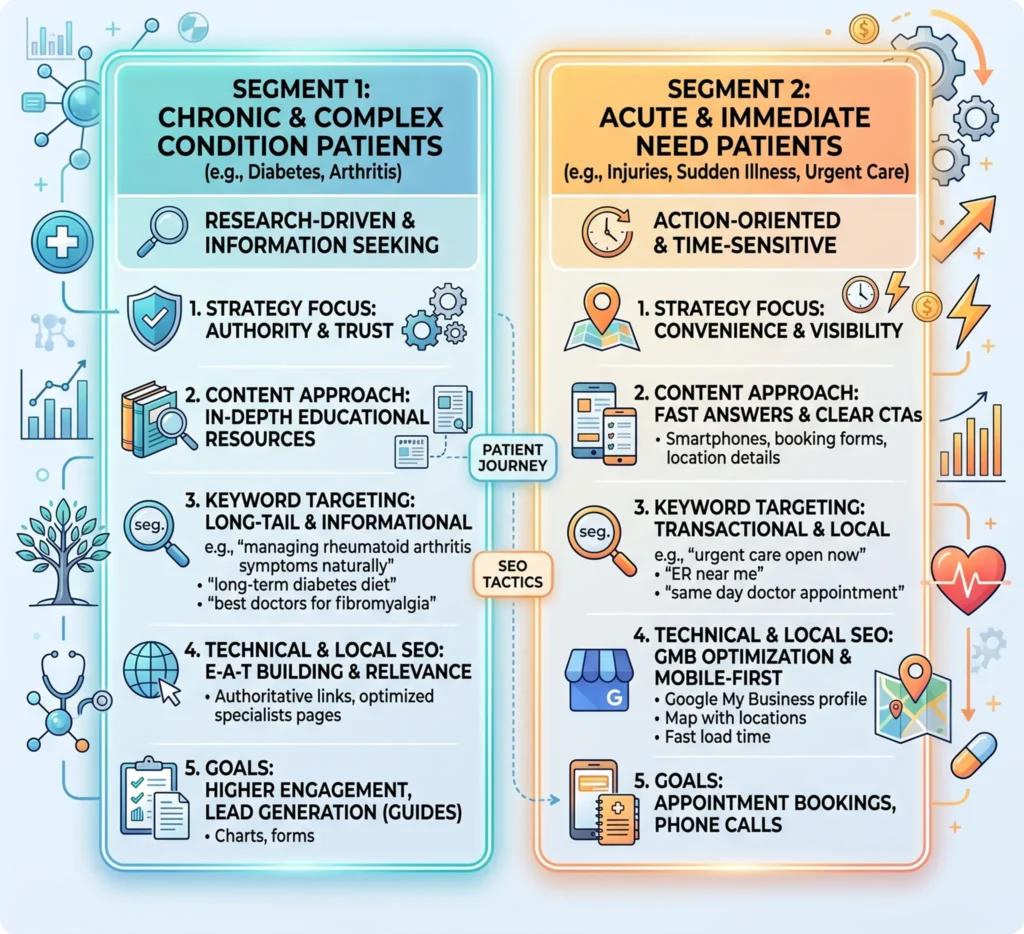
Two Patient Segments. Two Distinct SEO Strategies.
Orthodontic practices serve two fundamentally different audiences, and orthodontic keyword intent has split sharply between them. Invisalign searches are dominated by adults and professionals. Braces and early treatment searches are driven by parents researching for their children.
These segments search differently, respond to different content, and convert through different trust signals. Treating them the same way in your SEO produces mediocre results for both.
Adult Invisalign patients
Search: "Invisalign near me," "clear aligners for adults," "Invisalign cost [city]," "adult orthodontist [city]," "how long does Invisalign take." They're motivated by discretion, flexibility, treatment speed, and aesthetic outcome. They want to see results from patients who look like them — working adults, not teenagers with braces. They convert on professional credibility, clear cost transparency, and before-and-after results from adult cases.
Pediatric and teen patients
Are searched for by parents: "orthodontist for kids [city]," "braces for teens," "early orthodontic treatment [city]," "when should my child see an orthodontist," "kids braces cost." Parents are motivated by safety, a kid-friendly environment, insurance coverage, and a provider their child will feel comfortable with. They convert on parent reviews, family-friendly office content, and clarity about the treatment timeline for growing patients.
Most orthodontic practices need separate landing pages and Google Business Profile service entries for both segments — because the keyword targets, content requirements, and conversion signals are different enough that a single combined page underserves both audiences simultaneously.
Frequently Asked Questions: Orthodontist SEO
Dentist SEO prioritizes urgency — immediate searches from patients in pain or needing emergency care. Orthodontic SEO targets deliberate, research-driven queries from patients making considered decisions over weeks or months. The content requirements, keyword strategy, audience segmentation, and conversion architecture are fundamentally different. An SEO approach built for emergency dental searches consistently underperforms when applied to orthodontic practices. We build strategies specifically for how orthodontic patients search and decide.
Yes, and this is one of the most impactful structural decisions for orthodontic SEO. Invisalign patients and braces patients have different search behaviors, different concerns, and different conversion signals. A single “orthodontic treatments” page that combines them targets neither audience precisely — which means weaker rankings for both keyword clusters and lower conversion rates from both patient segments. We build separate, optimized pages for each treatment and each patient demographic.
You can expect 30 to 45 days for Google Maps movement, 60 to 90 days for consistent lead growth, and approximately 6 months for dominant local authority in your market. Orthodontic SEO compounds over time — the practices that invest consistently see the cumulative benefit of that work. We give you a realistic, market-specific timeline during the free audit.
Yes. Adult Invisalign patients and pediatric orthodontic patients search differently, convert differently, and need to see different content and trust signals before they book. We build audience-segmented pages and GBP service entries for both, targeting the specific keyword clusters and addressing the specific concerns that convert each audience into booked consultations.
Patient reviews directly influence both local search rankings and patient decision-making for orthodontic practices. Reviews that mention specific services — braces, aligners, Invisalign — provide context that search engines use to determine relevance. Generic reviews are less impactful than reviews describing specific treatment experiences and outcomes. We implement a review generation system that produces consistent, treatment-specific review volume — the kind that improves both local rankings and consultation conversion rates.
Invisalign markets its own brand heavily, which means your target patients already know what Invisalign is when they search for it. That brand awareness works in your favor — patients searching “Invisalign [city]” have already decided on the treatment type and are now choosing a provider. Those searches are among the highest-converting in orthodontic SEO. We optimize your practice to capture them at the local level where Invisalign’s national marketing cannot compete.
We work with both. Single-location practices need focused local authority in one market — deep GBP optimization, strong reviews, and competitive keyword coverage within their geographic catchment area. Multi-location groups need a scalable local SEO architecture that builds independent local authority for each location without cannibalizing rankings between offices. We build both strategies appropriately for the practice structure.