





Cosmetic Dentist SEO Services That Helps You Attract High-Value Patients Searching for Veneers, Smile Makeovers, and More

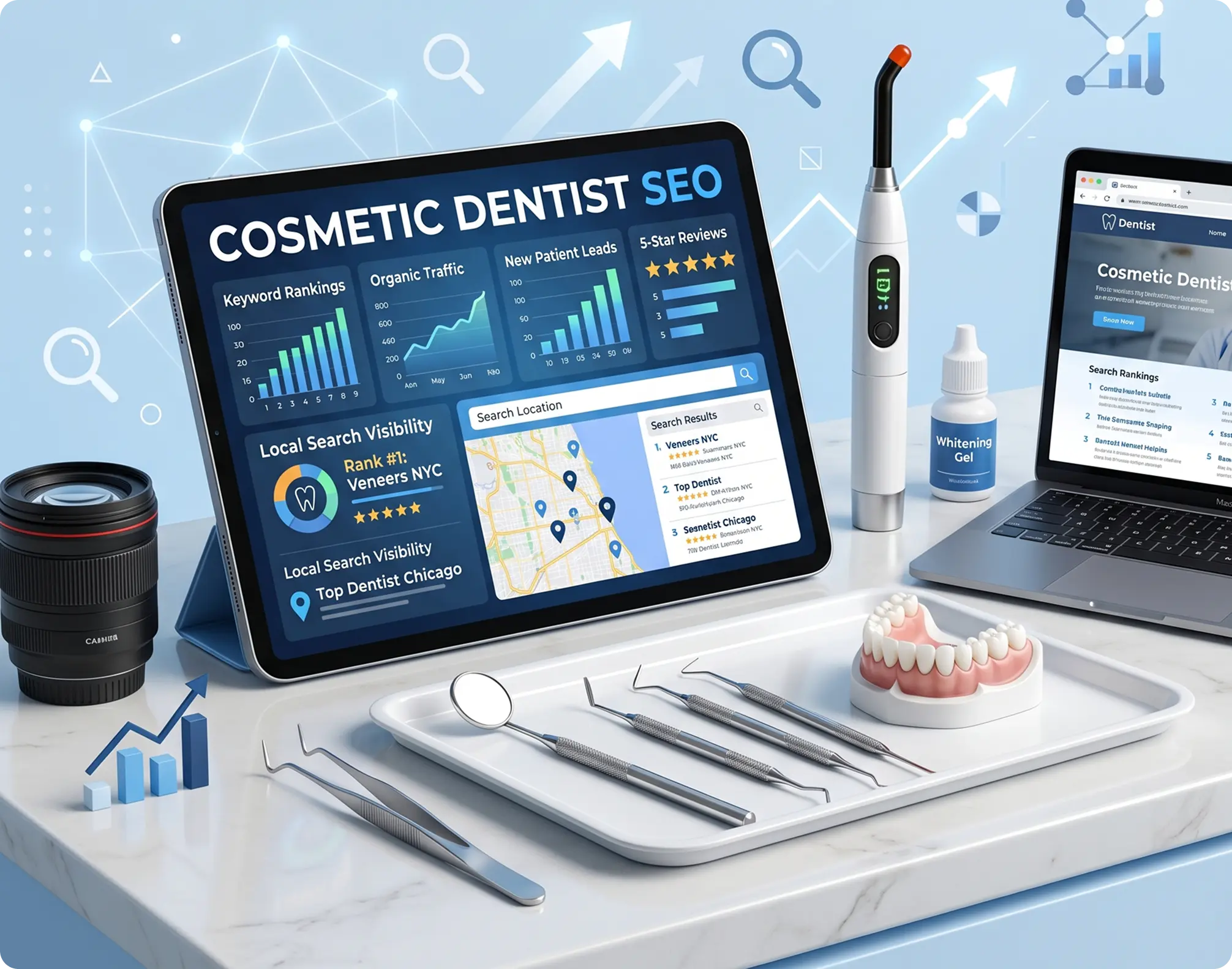
Cosmetic dentist SEO dashboard showcasing patient acquisition and growth.

Cosmetic dental patients are among the most research-intensive patients in all of dentistry. They compare providers carefully. They study before-and-after results. They read reviews extensively. They think about the decision for weeks before making a single call.

And every step of that research journey happens on Google.

Cosmetic patients prioritize trust, before-and-after visuals, financing options, and scheduling convenience above almost everything else. The practice they ultimately call is almost always the one that showed up consistently throughout their research — not the one that appeared in a single search at the bottom of the consideration process.

SEO built specifically for cosmetic dentistry puts your practice in front of these patients at every stage of that journey. At DentalSEOServices.co, that’s the only kind of SEO we build.

Cosmetic dentist SEO dashboard showcasing patient acquisition and growth.
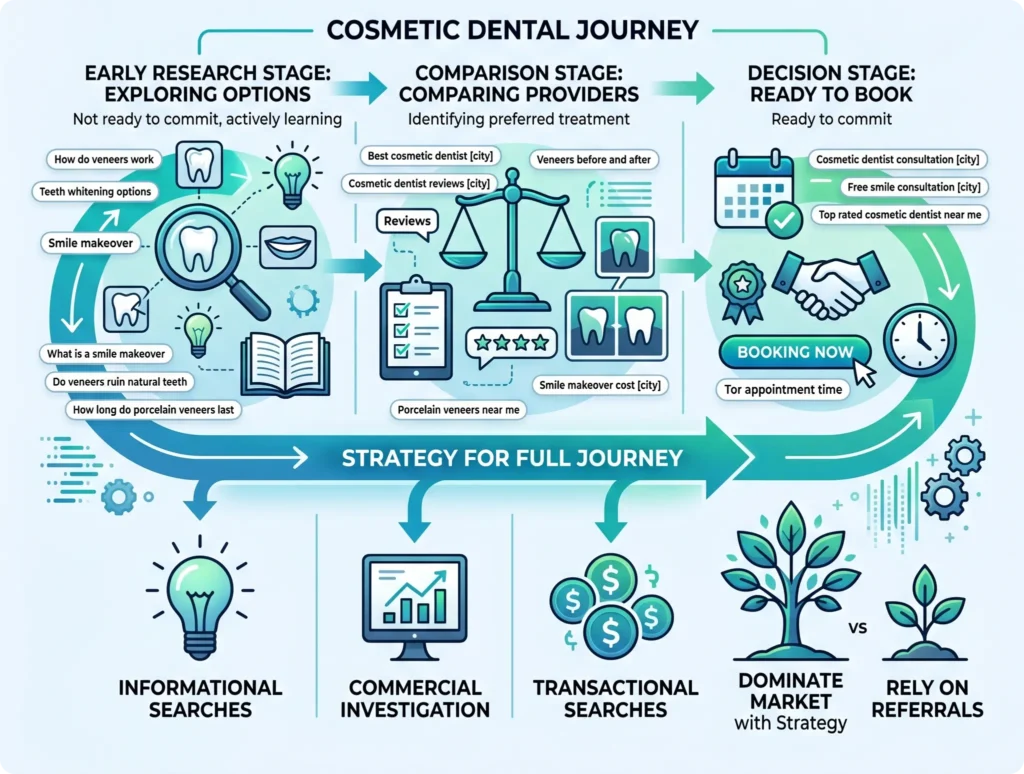
Cosmetic dental patient journey infographic showing treatment research stages.

How Cosmetic Dental Patients Search

Cosmetic dental patients search fundamentally differently than patients seeking medical or emergency dental care. Medical searches are driven by urgency and pain. Cosmetic searches are driven by results, appearance, and cost.

A patient with a toothache calls the first available dentist near them. A patient considering veneers spends weeks searching, comparing, and evaluating before they commit to a single consultation. Your SEO strategy has to reflect that difference — or it will rank for the wrong intent and convert at a fraction of its potential.

The cosmetic patient search journey looks like this.

Cosmetic dental patient journey infographic showing treatment research stages.

Early research stage

The patient is exploring options. They're not ready to commit, but they're actively learning. They search: "how do veneers work," "teeth whitening options," "what is a smile makeover," "do veneers ruin your natural teeth," "how long do porcelain veneers last."

Comparison stage

The patient has identified their preferred treatment and is now comparing providers. They search: "best cosmetic dentist [city]," "cosmetic dentist reviews [city]," "veneers before and after [city]," "smile makeover cost [city]," "porcelain veneers near me."

Decision stage

The patient is ready to book. They search: "cosmetic dentist consultation [city]," "free smile consultation [city]," "top rated cosmetic dentist near me."

Building a content strategy that covers the full patient journey — from informational searches like “what are porcelain veneers” through commercial investigation like “veneers cost [city]” to transactional searches like “cosmetic dentist [city]” — is what separates cosmetic practices that dominate their markets from those that rely entirely on referrals and word of mouth.

What Cosmetic Dentist SEO Involves

Procedure keyword strategy icon targeting cosmetic treatment search intent.

Procedure-Level Keyword Strategy

Keyword research for cosmetic dentistry must segment informational intent, commercial investigation, and transactional intent — and each segment requires different content built around different patient needs.

We map the complete cosmetic keyword landscape for your practice: procedure-specific terms for every treatment you offer (veneers, teeth whitening, composite bonding, smile makeovers, gum contouring, tooth reshaping), cost-focused searches, comparison searches, and location-modified queries targeting your specific market. Every keyword maps to a specific page or content asset built to capture that intent and move the patient toward a consultation.

Intent modifiers matter significantly in cosmetic dental SEO — phrases like "affordable," "cosmetic dentist near [neighborhood]," "porcelain veneers near me," and "smile makeover financing" reflect exactly where the patient is in their decision process and require different content strategies than generic procedure searches.

Cosmetic pillar page architecture icon organizing treatment related content.

Cosmetic Pillar Page and Procedure Cluster Architecture

The most effective cosmetic dental content structure uses a pillar page approach — a comprehensive "Cosmetic Dentistry" hub page supported by individual cluster pages for each procedure: veneers, bonding, whitening, smile makeovers. This architecture signals deep topical expertise to Google and captures patients searching for both the broad category and specific treatments.

We build this architecture from the ground up — the pillar page targeting "cosmetic dentist [city]," individual procedure pages targeting treatment-specific keywords, and supporting content that captures research-stage patients and moves them through to the conversion pages.

Local keyword strategy targeting nearby patients seeking dental services

Visual Content Optimization

Cosmetic procedures require detailed explanations, high-quality visuals, and patient transformation stories — because cosmetic patients research more before booking than virtually any other dental patient type.

We optimize every visual element of your cosmetic SEO: before-and-after image naming and alt text (not "IMG_1234.jpg" but "porcelain-veneers-before-after-smile-makeover.jpg"), photo gallery structure that Google can index and surface in image searches, and video content placement that increases time-on-page while earning rich result visibility.

Cosmetic patients make decisions based on what they see. Your SEO has to make sure what you've created for your patients is visible, indexed, and surfacing in the searches they're conducting.

E-E-A-T signals icon building trust for cosmetic dental content.

E-E-A-T Signals for Cosmetic Dental Content

Google evaluates dental content under YMYL (Your Money Your Life) guidelines — meaning the bar for expertise, authoritativeness, and trustworthiness is significantly higher than for non-healthcare content. Cosmetic dental pages that lack proper E-E-A-T signals rank poorly regardless of keyword optimization.

We build the E-E-A-T framework into every cosmetic page: author credentials, procedure-level clinical accuracy, transparent cost information, patient outcome evidence, and the trust architecture that tells Google this is a legitimate, expert cosmetic dental source — not generic dental marketing copy.

Local SEO optimization icon improving cosmetic dentist map visibility.

Local Map Pack Visibility for Cosmetic Searches

For cosmetic dental searches, the local map pack generates some of the highest conversion rates of any SERP feature — because patients searching "cosmetic dentist near me" are actively choosing a provider, not casually browsing.

We optimize your Google Business Profile with the "Cosmetic Dentist" secondary category, cosmetic procedure-specific service listings, photo content that demonstrates your cosmetic work, and the review strategy that builds the volume and quality signals that map pack rankings require. Cosmetic patients read reviews more thoroughly than almost any other patient type — review quality and recency are conversion factors as much as ranking factors.

Structured location page architecture icon supporting dental SEO scalability

Trust Signal Architecture

Research shows that "cosmetic dentist reviews [city]" generates significant search volume from patients who have already identified a practice and are validating their decision. Your SEO strategy has to account for this — patients will search for your practice by name combined with "reviews" before they book. What they find in those searches is a conversion factor, not just a reputation issue.
We build the trust signal architecture that supports cosmetic conversion: review generation systems, structured testimonial content, before-and-after case studies presented as SEO-optimized content assets, and the schema markup that surfaces your ratings and reviews directly in search results.

Why Cosmetic Dental SEO Requires a Specialist

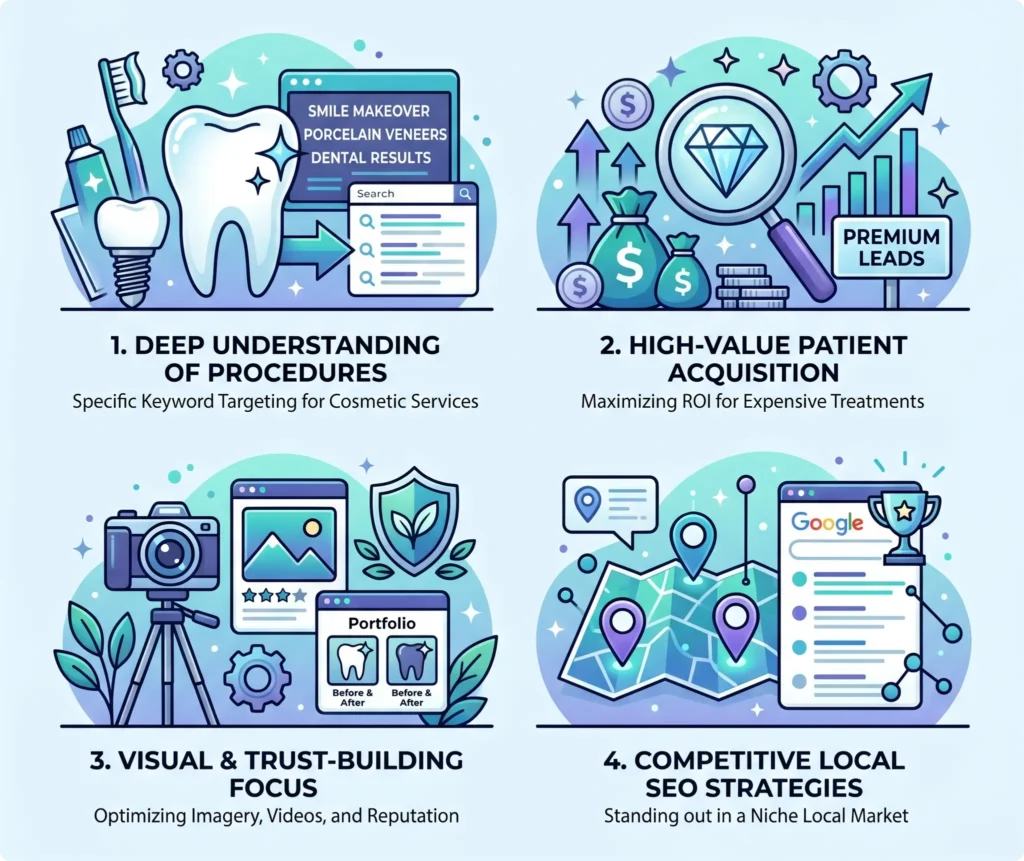
Cosmetic dental SEO infographic illustrating specialist strategies for growth.

Cosmetic dental patients are researching a significant financial and aesthetic decision. Conversion rates on dedicated cosmetic procedure pages — for veneers or smile makeovers — frequently outperform general service pages by 3 to 8 percent on form conversions, with higher rates for phone conversion when contact information is prominent. That performance gap comes from the specificity of the content — a page built specifically for a cosmetic patient’s concerns outconverts a generic dental page every time.

A generalist SEO agency builds one cosmetic dentistry page with standard keywords and calls it done. A dental SEO specialist understands that cosmetic patients need different content at different stages, that visual optimization matters as much as text, that E-E-A-T requirements for cosmetic dental content are more demanding than for most industries, and that the trust signals that convert cosmetic patients are distinct from what converts general dentistry patients.

That’s the only kind of SEO we build. No divided attention across industries. No generalist playbooks applied to a specialist patient type. Just cosmetic dental SEO, built by a team that works in dental every day.

Cosmetic dental SEO infographic illustrating specialist strategies for growth.

Frequently Asked Questions: Cosmetic Dentist SEO

How competitive is "cosmetic dentist [city]" as a keyword?

Achieving dominant, page-one rankings for competitive cosmetic dental terms like “cosmetic dentist [city]” typically takes 6 to 12 months of consistent effort. Competitiveness varies by market — a cosmetic dentist in a major metro like New York or Los Angeles faces significantly more competition than one in a mid-sized market. We assess your specific competitive landscape during the free audit and give you a realistic timeline based on actual data, not optimistic projections.

Should I have separate pages for each cosmetic procedure?

Yes — and this is one of the most impactful structural decisions in cosmetic dental SEO. A single service page listing all your procedures is one of the most common and costly dental SEO mistakes. Every high-value procedure deserves its own dedicated page optimized for the specific search intent of a patient considering that treatment. Veneers patients have different concerns than whitening patients. Smile makeover patients research differently than bonding patients. Each deserves a dedicated page built around their specific keyword intent and conversion needs.

How do before-and-after photos affect cosmetic dental SEO?

Significantly. Before-and-after images are not just trust signals for patients — they’re indexable visual content that can surface in Google Image searches, contribute to your page’s E-E-A-T signals, and increase time-on-page (a positive user behavior signal). We optimize every image with descriptive file names, alt text containing procedure and location keywords, and proper schema markup where applicable. Cosmetic practices with optimized visual libraries consistently outperform those treating photos as a purely aesthetic addition.

Do cosmetic dental patients use Google to find providers?

With 90% of patients researching online before booking an appointment, cosmetic dental patients — who research more extensively than almost any other patient type — are among the most search-dependent patients in the dental category. The question isn’t whether cosmetic patients use Google — it’s whether your practice is visible throughout the weeks of research they conduct before picking up the phone.

How does SEO handle the cost question for cosmetic procedures?

Transparently and strategically. Cosmetic patients actively search “veneers cost [city],” “smile makeover cost,” and “teeth whitening price.” Pages that avoid cost entirely lose these patients to competitors who address it. We build cost content that provides the honest framing and context cosmetic patients need — range information, factors affecting price, financing options — without locking you into specific numbers that make commitments difficult. Addressing cost on the page keeps patients engaged. Avoiding it sends them to competitors who don’t.

Is cosmetic dental SEO different from general dental SEO?

Yes. Medical dental keywords focus on pain, urgency, and treatment needs. Cosmetic dental keywords focus on results, cost, and appearance. Cosmetic procedures require more detailed explanations, visual proof, and patient stories because patients research more extensively before booking. The content requirements, trust signals, keyword intent, and conversion architecture for cosmetic dental pages are meaningfully different from general dental pages — and need to be treated that way.

Can you help with specific high-value cosmetic treatments like full-mouth reconstruction?

Yes. Full-mouth reconstruction, smile makeovers, and comprehensive cosmetic cases are among the highest-value treatments in dentistry and deserve their own SEO treatment. We build the dedicated pages, supporting content, and keyword strategy that attract patients searching for these high-commitment procedures — including the cost, process, and outcome content that moves a high-consideration patient toward booking a consultation.

Scroll to Top