




Emergency Dentist SEO That Help Your Practice Rank When Patients Need Care Right Now
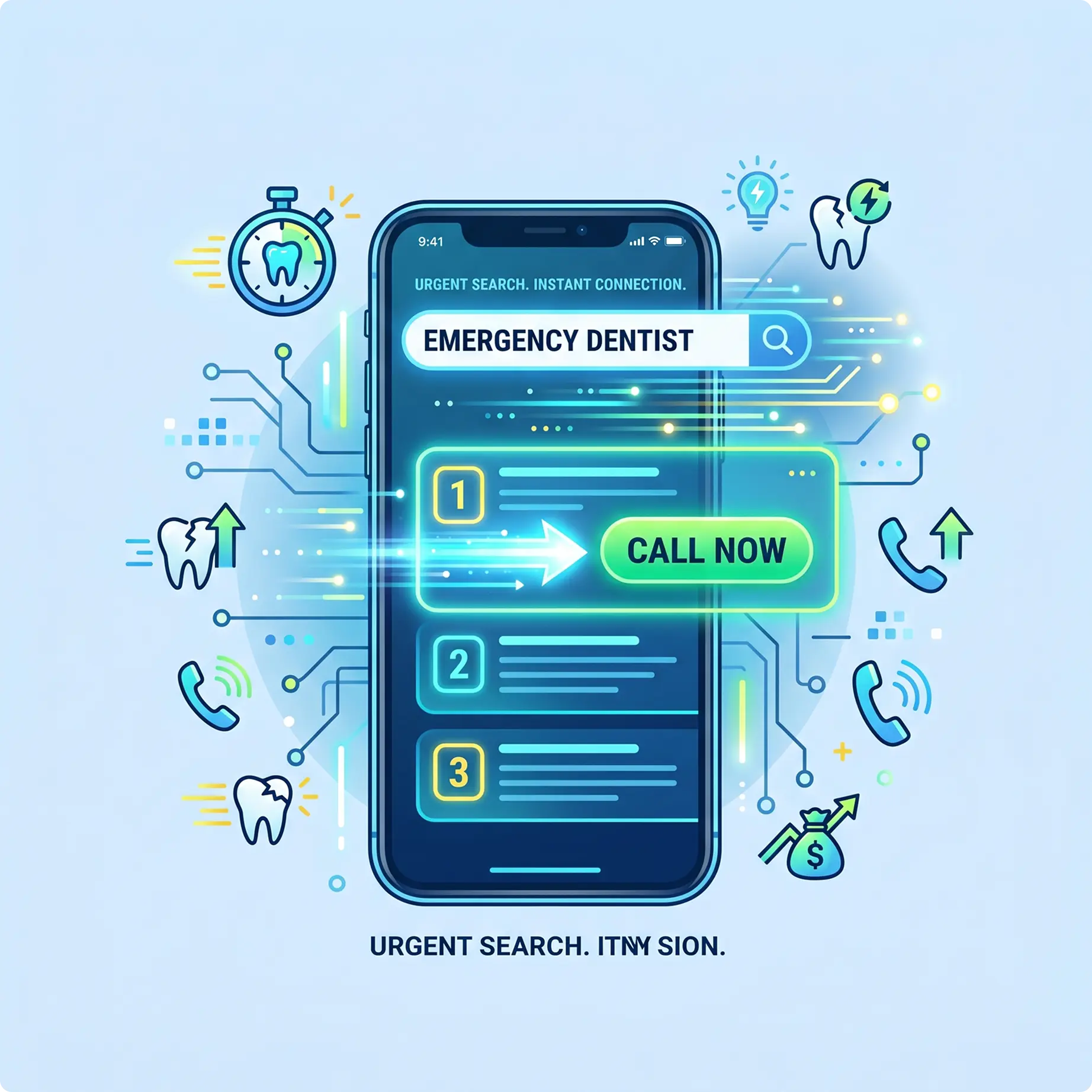
No dental search converts faster than an emergency search. A patient with a broken tooth, severe toothache, or knocked-out tooth isn’t comparing providers, reading about treatment options, or deliberating over reviews for three weeks. They’re in pain. They need help immediately. They search, they scan the first three results, and they call within minutes.
“Emergency dentist near me” searches convert at 89% higher rates than general dental terms. These patients have immediate problems and need solutions today.
That conversion rate is the highest in all of dental search. And yet the majority of emergency dental practices have no dedicated SEO strategy for emergency keywords — they list “emergency services” on a general services page and hope patients find them. They don’t. Patients find the practice that shows up first, loads fast, and communicates availability clearly. That practice gets the call. Every time.
At DentalSEOServices.co, we rank emergency dental practices for the searches that produce same-day patient calls. The entire strategy is built around one reality: in emergency dental, being visible and accessible at the exact moment a patient needs you is the entire game.


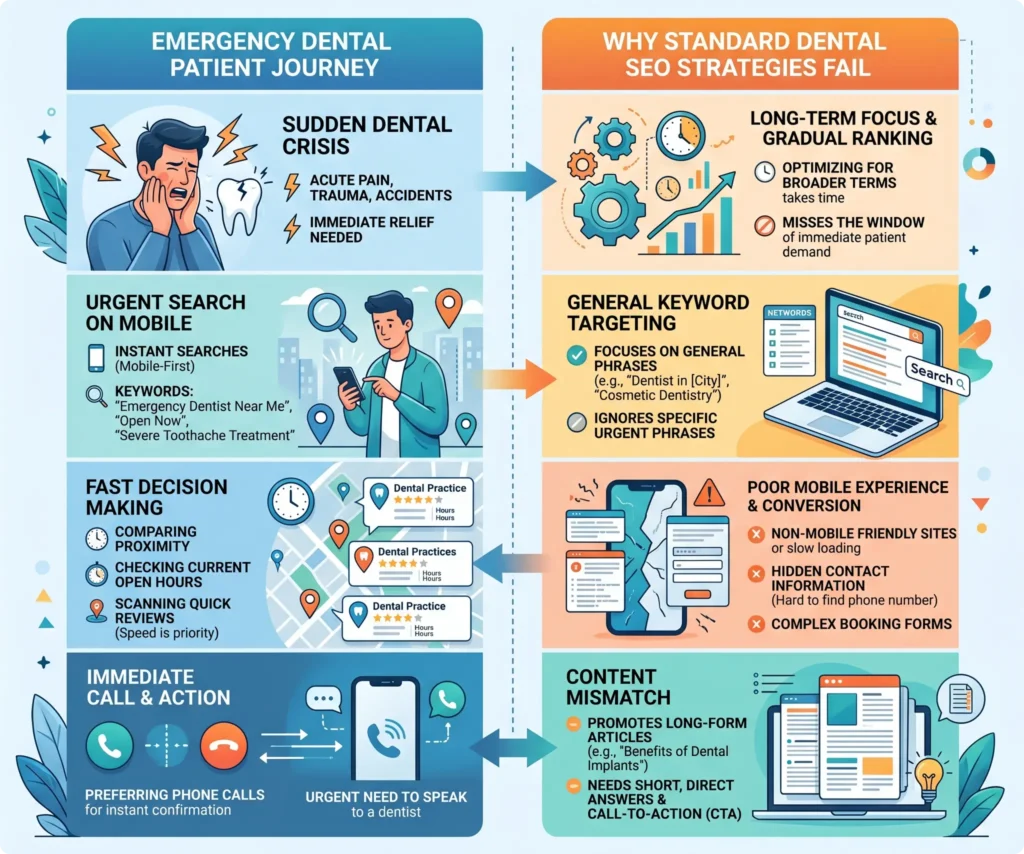
How Emergency Dental Patients Search — and Why Standard Dental SEO Fails Them
Emergency dental patients behave differently from every other dental patient type. Understanding that difference is the foundation of effective emergency dental SEO.
Emergency dental search intent is highly localized and time-sensitive. Patients commonly search phrases such as “emergency dentist near me,” “toothache dentist,” “same-day dentist,” and “urgent dental care.” They are rarely loyal in an emergency unless they already have an established dentist. Instead, they search based on immediate availability, location, and confidence that the provider can help.
The decision timeline is minutes, not weeks. A patient searching for Invisalign will spend days comparing providers. A patient with a dental abscess at 10 PM is calling whoever appears first, loads fast, and shows they’re available. There is no comparison stage. There is no research journey. There is only: does this practice appear, and can they see me now?
Emergency dental searches are overwhelmingly mobile — patients in pain search from their phone, often while managing a panicking child or holding their jaw. Your website must be mobile-first, your phone number must be prominent and clickable above the fold, and your hours must be accurate and visible before a patient needs to scroll. Any friction — slow load times, buried contact information, confusing navigation — sends the patient to the next result immediately and permanently.
Standard dental SEO is built for patients who have time. Emergency dental SEO is built for patients who don’t. The technical requirements, content structure, and keyword architecture are fundamentally different — and must be treated that way.
What Emergency Dentist SEO Looks Like in Practice

Mobile Speed as a Conversion Factor
For emergency dental websites, page speed is not just an SEO ranking factor — it is the conversion factor. A patient in pain who lands on a slow-loading page doesn't wait. They hit back and call the next practice.

Mobile pages that load in under three seconds have dramatically higher conversion rates, but the average dental website takes seven or more seconds to fully load on mobile devices. That gap between three seconds and seven seconds is where emergency patients are lost — not to better competitors, but to impatience driven by pain.
We optimize your site's Core Web Vitals, server response time, image compression, and mobile performance to achieve sub-two-second load times. For emergency practices, this technical work is as important as any content or keyword strategy. A perfectly optimized emergency page that loads in eight seconds loses to a mediocre page that loads in one second.

Availability Signal Optimization
Your SEO strategy needs to clearly communicate real availability — extended hours, weekend hours, same-day appointments, and after-hours emergency lines — through your Google Business Profile, website content, and structured data so Google and patients both understand you are genuinely available when they need you.

Hours accuracy on your Google Business Profile is non-negotiable. Google uses your listed hours to determine whether to show your practice for "open now" searches, and incorrect hours mean you disappear from results exactly when emergency patients need you most. We audit, correct, and maintain your availability signals across every platform Google references — GBP, website schema, citation listings — so your practice appears for availability-based queries at every hour you're genuinely open.
We also target the availability-specific keyword cluster that emergency practices consistently underutilize: "dentist open now," "24 hour dentist near me," "weekend dentist [city]," "same-day dental appointment [city]," "emergency dentist open Saturday." These searches have immediate booking intent and lower competition than the core "emergency dentist near me" term.

Emergency-Specific Keyword Architecture
Emergency service pages target high-intent queries — "emergency dentist [city]," "toothache relief near me," "knocked out tooth what to do." Each page includes immediate-action content: what to do right now, when to seek emergency care, and a prominent call-to-action to contact your practice.

We build the keyword architecture that captures emergency patients across the full spectrum of urgent dental searches — from the high-intent "emergency dentist near me" core term to symptom-specific searches that patients conduct before they know they need emergency care:
"broken tooth what to do" "tooth pain won't stop" "dental abscess symptoms" "knocked out tooth emergency" "cracked tooth pain" "swollen jaw dentist" "toothache can't sleep"
Each symptom search represents a patient at peak urgency — exactly the moment when they're most likely to call and book a same-day appointment.

Symptom-Specific Content That Ranks and Converts
Emergency dental pages that move fastest in local rankings include content covering symptoms that trigger the search, when treatment is urgent, appointment availability, what happens during the visit, and sedation options for anxious patients.

We build symptom-specific service pages for the most common dental emergencies your practice handles — broken teeth, severe toothaches, knocked-out teeth, dental abscesses, lost fillings, cracked crowns — each page structured to answer three questions patients have before they call: is this actually an emergency, can you see me today, and what will happen when I come in?
This content structure serves two purposes simultaneously. It ranks for the symptom-specific searches that precede emergency calls, and it converts those visitors into patients by giving them immediate, clear answers that reduce anxiety and lower the barrier to calling.

Google Business Profile Optimization for Emergency Searches
We optimize your Google Business Profile with emergency-specific categories, accurate and prominent hours of operation including after-hours and weekend availability, click-to-call functionality, emergency service menus, and patient review management so your practice appears at the top of map pack results when patients search "emergency dentist near me."

Practices ranking in the top three Google map pack positions receive 70% of all website clicks — and for emergency searches, the map pack dominates even more heavily than for other dental queries because patients in urgent situations want proximity and availability confirmed immediately, not after clicking through to a website.

Review Strategy Tuned for Emergency Trust Signals
Emergency patients choose providers based on availability first and trust second. A patient scanning three map pack results will call the practice with the most reviews and the highest rating. We help your practice build a systematic review generation process that produces a steady stream of recent reviews highlighting same-day availability, pain relief, and after-hours responsiveness — the exact signals that make emergency patients choose your practice over competitors.
Generic reviews that say "great dentist" do less work for emergency SEO than reviews that specifically mention: "they saw me the same day," "I called at 7 PM and they got me in," "I was in so much pain and they made it stop." We build the review request framework that generates the treatment-specific, experience-specific reviews that convert emergency searchers into callers.
The Emergency Dental Competitive Landscape
Emergency dentistry is one of the most competitive and volatile areas of local healthcare search. Multiple practices often target the same emergency keywords, and new competitors can appear quickly when practices recognize the conversion value of emergency searches.
The practices that consistently dominate emergency search have three things competitors don’t: genuinely fast mobile performance, crystal-clear availability signals, and a review profile that specifically validates emergency responsiveness. We build all three.
Frequently Asked Questions: Emergency Dentist SEO
“Emergency dentist near me” searches convert at 89% higher rates than general dental terms because patients have an immediate, non-deferrable need. They are not browsing or comparing — they are in pain and ready to call whoever appears first and communicates availability clearly. The intent behind the search is as high as any search in local healthcare, which makes ranking for emergency terms one of the highest-ROI investments in dental SEO.
Critical — more so than for any other dental specialty. Emergency dental searches are overwhelmingly mobile. For emergency dental websites, page speed is not just an SEO ranking factor — it is the conversion factor. A patient in acute pain who encounters a slow-loading page immediately hits back and calls the next result. We target sub-two-second mobile load times for every emergency dental engagement because the conversion difference between two seconds and seven seconds is measurable in lost patient calls.
Google uses your listed hours to determine whether to show your practice for “open now” searches. Incorrect hours mean you disappear from results exactly when emergency patients need you most. We audit your hours across every platform Google references — Google Business Profile, structured data, citation listings — and ensure they’re accurate, consistent, and updated for holidays and after-hours availability. Practices with accurate, complete hours listings appear for “open now” searches; practices with incomplete or outdated hours disappear at the moments they’d otherwise be converting.
Each emergency service page should include immediate-action content — what to do right now, when to seek emergency care, and a prominent call-to-action to contact your practice. Beyond a core emergency dentist page, symptom-specific pages for the most common emergencies your practice handles — broken teeth, severe toothaches, dental abscesses, knocked-out teeth — capture patients at the highest urgency moments. Your phone number must be clickable and visible above the fold on every page, and your hours must be immediately accessible without scrolling.
Your GBP is the primary driver of map pack visibility for emergency searches — and map pack visibility is where emergency patients call from. We optimize your GBP with emergency-specific categories, accurate and prominent hours including weekend and after-hours availability, click-to-call functionality, emergency service menus, and review management so your practice appears at the top of map results when patients search “emergency dentist near me.” Hours accuracy, category selection, and review recency are the three most impactful GBP factors for emergency search visibility.
Reviews that highlight same-day availability, pain relief outcomes, and after-hours responsiveness are the most valuable for emergency dental practices. A review that says “they got me in the same day I called and I was out of pain within an hour” does more for emergency search conversion than ten generic five-star reviews. We build the review request process that generates treatment-specific, experience-specific reviews from your emergency patients — the ones that convert the next emergency patient who reads them before calling.
Google Business Profile optimization and hours accuracy improvements can produce map pack movement within 30 to 45 days for most markets. Emergency keyword rankings for core terms like “emergency dentist [city]” typically follow within 60 to 90 days with proper on-page and authority signals in place. Emergency SEO generally produces results faster than elective dental specialties because the search intent is so high that Google rewards well-optimized, genuinely available practices quickly.