
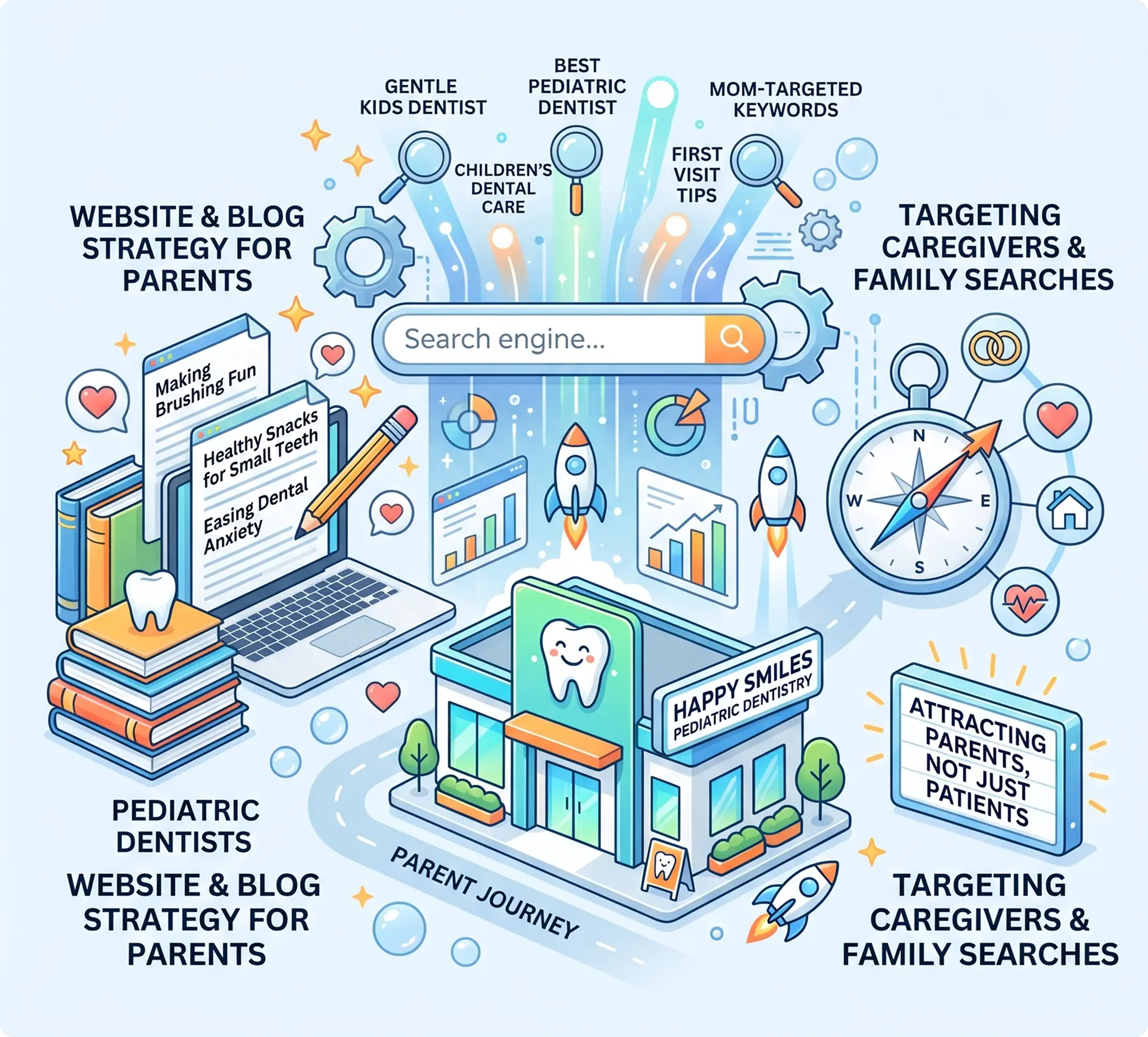









Pediatric Dentist SEO Servives That Help You Rank for the Searches Parents Make for Their Children
Pediatric dental SEO is unique because your target audience is parents — not the patients themselves. Your website content, blog strategy, and the keywords you target need to resonate with moms, dads, and caregivers who are searching on behalf of their children.
That distinction changes everything. The keywords parents use are different from what children would search. The content that converts a parent is different from what converts an adult dental patient. The trust signals that make a parent choose your practice over the practice down the street are built on emotional safety, gentleness, and the confidence that their child will be okay — not on clinical credentials or treatment outcomes alone.
Parents in 2026 research everything online before booking their child’s first dental appointment. They read reviews, compare websites, check Google Maps ratings, and ask other parents for recommendations — often all within a single evening. If your pediatric practice is not visible, credible, and parent-friendly at every one of those touchpoints, you are losing new patient families to competitors who have made it easier for parents to say yes.
At DentalSEOServices.co, we build SEO for pediatric dental practices around how parents actually search — not how dental patients search. There is a meaningful difference, and it’s the foundation of everything we build.


How Parents Search for Pediatric Dentists
Parents searching for a pediatric dentist are not making a quick, transactional decision. They are making a trust decision on behalf of someone they are responsible for protecting. That changes the psychology of the search, the keywords they use, the content they need to see before they call, and the reviews they read before they commit.
Pediatric dentistry advertising and SEO operate on entirely different psychological triggers than general dental marketing. While adult patients evaluate clinical credentials and treatment outcomes, parents prioritize emotional safety, anxiety management, and their child’s comfort above technical expertise. This fundamental shift requires a complete rethinking of messaging, content, and conversion strategy.
A parent searching “pediatric dentist near me” is asking: will my child be safe here? Will the dentist be patient and gentle? Will my child leave without a traumatic experience that follows them into adulthood? Your SEO has to answer those questions — not just rank for the keyword.
The parent research journey moves through three distinct stages.
Initial search
The parent identifies a need. First dental visit, a cavity, dental anxiety, or a new family in town looking for a pediatric practice. They search: "pediatric dentist near me," "children's dentist [city]," "best kids dentist [city]," "first dental visit toddler."
Evaluation stage
The parent narrows down options. They're reading reviews, looking at photos of the office, checking whether the practice handles anxious children, looking at the team. They search: "pediatric dentist [city] reviews," "dentist good with anxious kids [city]," "kids dentist gentle [city]," "pediatric dentist accepting new patients [city]."
Specialty searches
Parents with specific needs search for practices that address them. They search: "autism-friendly dentist [city]," "sedation dentist for children [city]," "pediatric emergency dentist [city]," "first dental visit age 1 [city]," "dentist for special needs children."
What Pediatric Dentist SEO Involves

Parent-Focused Keyword Strategy
The highest-value pediatric dental keyword clusters reflect the full range of parent search behavior: "pediatric dentist near me" and "children's dentist [city]" for primary local intent, "emergency pediatric dentistry" for urgent situations, "Invisalign for teens" for orthodontic crossover searches, and "special needs dentistry" for specialized care — each requiring dedicated pages addressing specific parent concerns.

Pediatric-specific long-tail keywords like "pediatric dentist for toddlers in [city]," "autism-friendly dentist," "first dental visit age 1," and "sports mouthguard dentist for teens" attract qualified parents rather than general dental browsers. These terms have lower competition and higher conversion rates because the search intent is so specific.
We map the complete parent keyword landscape for your practice — from primary local terms through specialty and age-specific searches — and build the page structure and content that captures parents at every stage of their decision.

Age-Segmented Content Architecture
Pediatric dental patients span from infants through teenagers — and parents of a two-year-old search differently and need different reassurance than parents of a fourteen-year-old. Treating them as a single audience in a single page produces content that speaks adequately to neither.

We build age-segmented content that addresses each audience specifically:
Infants and toddlers (ages 1-3)
Parents in this segment are searching for first dental visit guidance, what to expect, how to prepare a toddler for the dentist, and whether early dental visits are necessary. Content for this audience prioritizes reassurance, developmental milestones, and a gentle, non-threatening first visit experience.
School-age children (ages 4-12)
Parents are searching for cavity treatment, dental anxiety management, sealants, and regular preventive care. Content addresses practical concerns: what treatments are available, how anxious children are handled, what a typical appointment looks like.
Teenagers (ages 13-18)
Parents and teens themselves are searching for orthodontic options, sports mouthguards, wisdom teeth, and cosmetic awareness. Content targets both the parent making the appointment and the teen who increasingly has a voice in the decision.

Trust Signal Architecture Built for Parents
96% of consumers read reviews before choosing local businesses — and for pediatric dental practices, parents read reviews more carefully and weight them more heavily than almost any other healthcare decision they make for their children.

The reviews that convert pediatric dental patients aren't generic five-star ratings. They're reviews from parents describing how the dentist handled their anxious child, how the staff made their toddler laugh, how their child now actually looks forward to dental visits. We implement a review generation system that produces consistent, experience-specific reviews from satisfied patient families — the kind that make the next parent reading them immediately trust your practice.
Beyond reviews, we build the complete trust signal architecture that converts cautious parents: team bios that communicate warmth and child-specific training, photo content that shows a genuinely welcoming and child-friendly environment, before-and-after content showing positive patient experiences (not clinical outcomes), and FAQ content that directly addresses the anxiety-related questions parents ask before they call.

Google Business Profile Optimization for Pediatric Searches
When a parent searches "pediatric dentist near me," the Google Maps local pack dominates the results. Practices appearing in the top three local results capture 60 to 70% of all clicks.

We optimize your Google Business Profile with the "Pediatric Dentist" primary category, age-specific service listings that communicate your full scope of care, photo content that shows your child-friendly environment rather than clinical equipment, and the review response framework that demonstrates the warmth and responsiveness parents are evaluating when they read how you interact with your community.
Six critical GBP elements increase parent click-through rates: accurate NAP consistency across all online directories, clear age ranges served from infants through teens, specific service descriptions that address parental concerns, regular photo updates showing the child-friendly environment, active review management, and complete hours information including any Saturday or after-school appointment availability.

Anxiety Management Content as an SEO Asset
Dental anxiety in children is one of the most-searched concerns among pediatric dental parents. "Dentist good with anxious kids," "how to prepare anxious child for dentist," "pediatric dentist sedation options" — these searches represent parents who are specifically looking for a practice that understands their child's challenges.

Content that addresses dental anxiety directly — what your practice does specifically to create a calm experience, how your team is trained to handle fearful children, what sedation options are available and when they're appropriate — does double duty: it ranks for high-intent anxiety-specific searches and it converts the parents who read it into patients because it answers their primary fear before they call.

Schema Markup for Pediatric Practices
We implement the complete schema stack for pediatric dental practices: MedicalBusiness and Dentist schema with pediatric specialty signals, LocalBusiness schema with accurate location and hours data, Service schema with age-specific service entries, AggregateRating schema that surfaces your star rating directly in search results, FAQPage schema targeting the parent questions that appear in People Also Ask boxes, and Person schema for each provider's pediatric credentials and training.
This structured data tells Google and AI search systems exactly what your practice specializes in — pediatric dental care, not general dentistry — and which patient age ranges you serve.
Why Pediatric Dental SEO Requires a Specialist
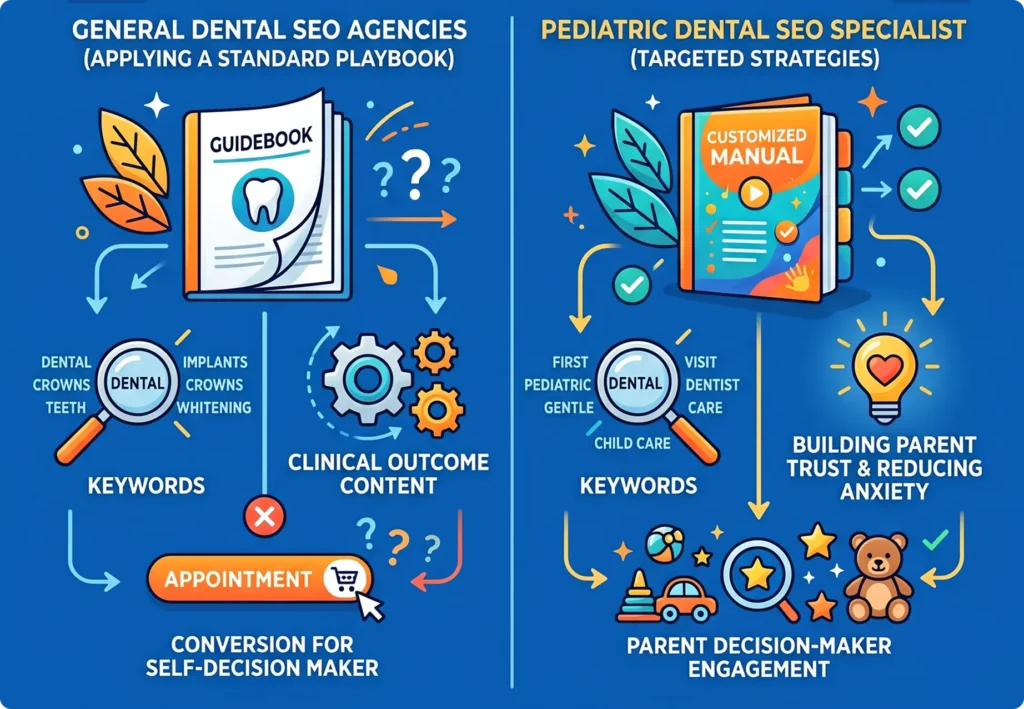
General dental SEO agencies apply the same playbook across every dental specialty. That playbook is built around adult patients making decisions for themselves — keyword-optimized service pages, clinical outcome content, and conversion flows designed for the patient who is also the decision-maker.
Pediatric dental SEO is built for a completely different dynamic. The decision-maker is a parent. The patient is a child. The conversion signals that work are emotional, not clinical. The keywords that convert are parent-language, not patient-language. The reviews that matter are parent experiences, not patient ratings.
We build pediatric dental SEO with that distinction at the center of every decision — not as an afterthought applied to a general dental template.
Frequently Asked Questions: Pediatric Dentist SEO
Pediatric dental SEO is unique because your target audience is parents, not the patients themselves. Your website content, blog strategy, and keywords need to resonate with parents and caregivers searching on behalf of their children. The keywords parents use, the content they need to see before converting, and the trust signals that make them choose your practice are all meaningfully different from what works for adult dental patients. A general dental SEO strategy applied to a pediatric practice consistently underperforms because it’s built for the wrong audience.
The highest-converting pediatric dental keywords combine a specific audience, service, or concern with a location modifier. Primary terms like “pediatric dentist near me” and “children’s dentist [city]” target parents with immediate booking intent. Specialty long-tail terms like “pediatric dentist for toddlers [city],” “autism-friendly dentist,” “first dental visit age 1,” and “dentist for anxious children” attract highly qualified parents whose specific needs you can address — and convert at higher rates despite lower search volume.
Extremely important — more so than for most dental specialties. Parents research everything before booking their child’s first dental appointment, reading reviews, comparing websites, checking Google Maps ratings, and asking other parents for recommendations — often all within a single evening. Reviews that describe how the team handled an anxious child, how the practice made a toddler comfortable, or how a child now actually enjoys dental visits are among the highest-converting trust signals a pediatric practice can build.
Google Business Profile optimization typically produces map pack movement within 30 to 45 days for most markets. First page organic rankings for primary pediatric terms generally follow within 3 to 5 months with proper on-page and authority signals in place. Specialty and long-tail terms — “autism-friendly dentist [city],” “pediatric dentist for toddlers [city]” — often rank faster due to lower competition. We provide a market-specific timeline during the free audit.
Yes, and this is one of the highest-impact structural decisions for pediatric dental SEO. Parents of infants and toddlers have different concerns, use different search terms, and need different reassurance than parents of school-age children or teenagers. A single combined “pediatric dentistry” page addresses none of these audiences precisely. Age-segmented pages expand your keyword footprint across multiple parent search clusters and convert each audience more effectively than a combined page.
Content that specifically describes what your practice does to create a calm, non-threatening experience for anxious children — the techniques your team uses, the sedation options available, how you prepare fearful children before procedures, and reviews from parents of anxious patients describing their child’s experience. Parents searching “dentist good with anxious kids [city]” are specifically looking for evidence that your practice can handle their child’s situation. Content that addresses this directly converts this high-intent audience far more effectively than generic pediatric dentistry content.
Yes. “First dental visit” searches represent parents at the very beginning of their child’s dental journey — the highest-value relationship to establish because a positive first experience produces a multi-year, multi-child patient family. We build the content that ranks for first-visit searches and answers the questions parents have before that appointment: when to start, what to expect, how to prepare a toddler, and what makes your practice the right choice for a child’s very first dental experience.
The primary GBP category must be “Pediatric Dentist” — not the generic “Dentist” category — to signal your specialty to Google for pediatric-specific searches. Service listings should reflect your full scope of pediatric care with age-specific language. Photo content should prioritize your child-friendly environment, team interactions with young patients, and the welcoming atmosphere parents are evaluating before they visit. We also ensure your hours reflect any after-school or Saturday availability that is a significant booking factor for working parents.